Abstract
Metadata, commonly referred to as “data about data,” constitutes an essential component of digital forensics. It provides embedded informational attributes that facilitate the identification, authentication, and contextual understanding of digital documents. This short article explores the nature of metadata, its typology, and the methodologies through which forensic document examiners analyze metadata to ascertain document provenance, detect alterations, and establish evidentiary validity.
1. Introduction
In contemporary forensic practice, the investigation of digital evidence has become integral to the examination of documentary materials. Unlike traditional physical documents, electronic files inherently retain a digital footprint consisting of metadata—informational elements generated automatically by operating systems, applications, or users during the creation, modification, and transmission of a file.
From a forensic standpoint, metadata serves as a silent witness, capable of revealing details that are not immediately apparent in the visible contents of a document. The forensic examination of metadata, therefore, provides an indispensable tool for identifying authenticity, reconstructing document history, and detecting fraudulent alterations.
2. Defining Metadata
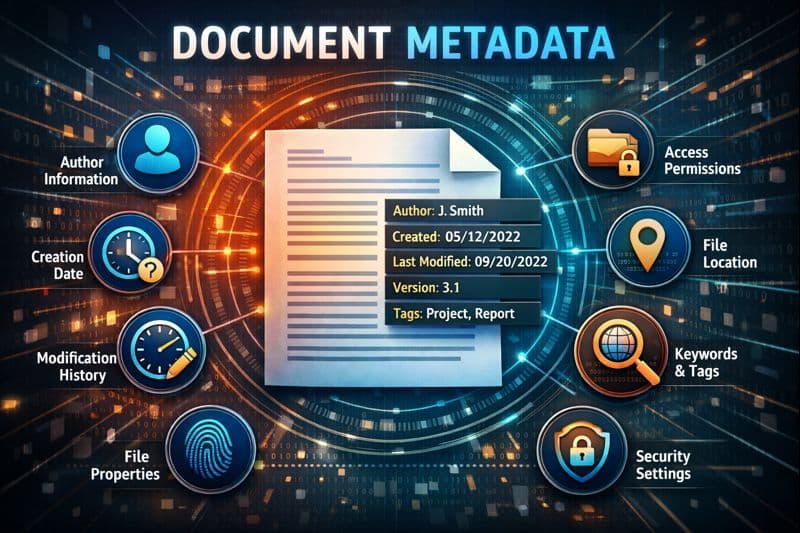
Metadata may be defined as the structured information that describes, explains, or contextualizes primary data. In digital documents, it provides descriptive, administrative, and technical details about the file. Typical metadata fields include, but are not limited to, author identity, date and time of creation, modification timestamp, software version, file path, and system identifiers.
Metadata is generally classified into three principal categories:
-
System Metadata: Generated by the operating system, this category includes data such as file creation, modification, and access times, as well as size and location information.
-
Application Metadata: Produced by specific software applications, this type may include details such as author name, template information, word count, or tracked changes.
-
Embedded Metadata: Encompassed within the file structure itself, embedded metadata (e.g., EXIF data in images or internal properties in PDFs) is integral to the file’s format and functionality.
Each category serves a distinct forensic function in reconstructing a document’s origin and transformation over time.
3. Metadata Analysis in Forensic Document Examination
The analytical process undertaken by forensic document examiners involves systematic extraction, verification, and interpretation of metadata through specialized forensic methodologies.
3.1 Extraction of Metadata
The initial phase consists of the secure extraction of metadata using forensic tools designed to preserve evidentiary integrity. Tools such as EnCase, FTK Imager, ExifTool, or Autopsy are widely utilized for this purpose. These applications allow examiners to produce duplicable and verifiable outputs that comply with evidentiary standards of admissibility.
3.2 Verification of Authenticity
Examiners scrutinize temporal metadata elements—such as creation and modification timestamps—to identify inconsistencies suggestive of tampering or post-dating. For instance, a document purporting to have been authored in a specific period may reveal metadata indicating subsequent modifications that contradict testimonial or contextual assertions.
3.3 Source Attribution
Metadata may disclose identifiers linking the document to a specific user, device, or software environment. This information is invaluable in attribution analysis, particularly in cases involving anonymous publications, disputed authorship, or intellectual property violations.
3.4 Revision History Examination
Certain formats, such as Microsoft Word or portable document format (PDF) files, preserve revision histories, author comments, and tracked changes. The analysis of these attributes can demonstrate document evolution, reveal unauthorized edits, or assist in establishing chronology within collaborative workflows.
3.5 Cross-Referencing and Correlation
Forensic analysts often engage in comparative analysis of metadata across multiple files or systems. By correlating data points—such as uniform time zones, software versions, or naming conventions—examiners may link documents to a common origin or editing environment, supporting broader investigative conclusions.
4. Evidentiary Considerations and Limitations
While metadata is a powerful evidentiary resource, it must be interpreted with caution. Metadata can be intentionally modified, stripped, or fabricated using readily accessible software tools. Accordingly, conclusions derived from metadata analysis should be corroborated with supplementary forensic evidence, such as system logs, email headers, or version control archives. Moreover, the chain of custody and forensic imaging protocols must be rigorously observed to maintain the admissibility and probative value of metadata-derived findings.
5. Conclusion
Metadata analysis stands as a critical discipline within forensic document examination. It enables the reconstruction of document history, authentication of digital evidence, and identification of the technical and human factors underlying document creation. As the production and exchange of digital documents continue to dominate personal, corporate, and legal communication, proficiency in metadata interpretation remains an imperative skill for forensic examiners and legal practitioners alike. Effective utilization of metadata contributes not only to evidentiary reliability but also to the broader goal of ensuring accuracy and integrity in digital documentation.