
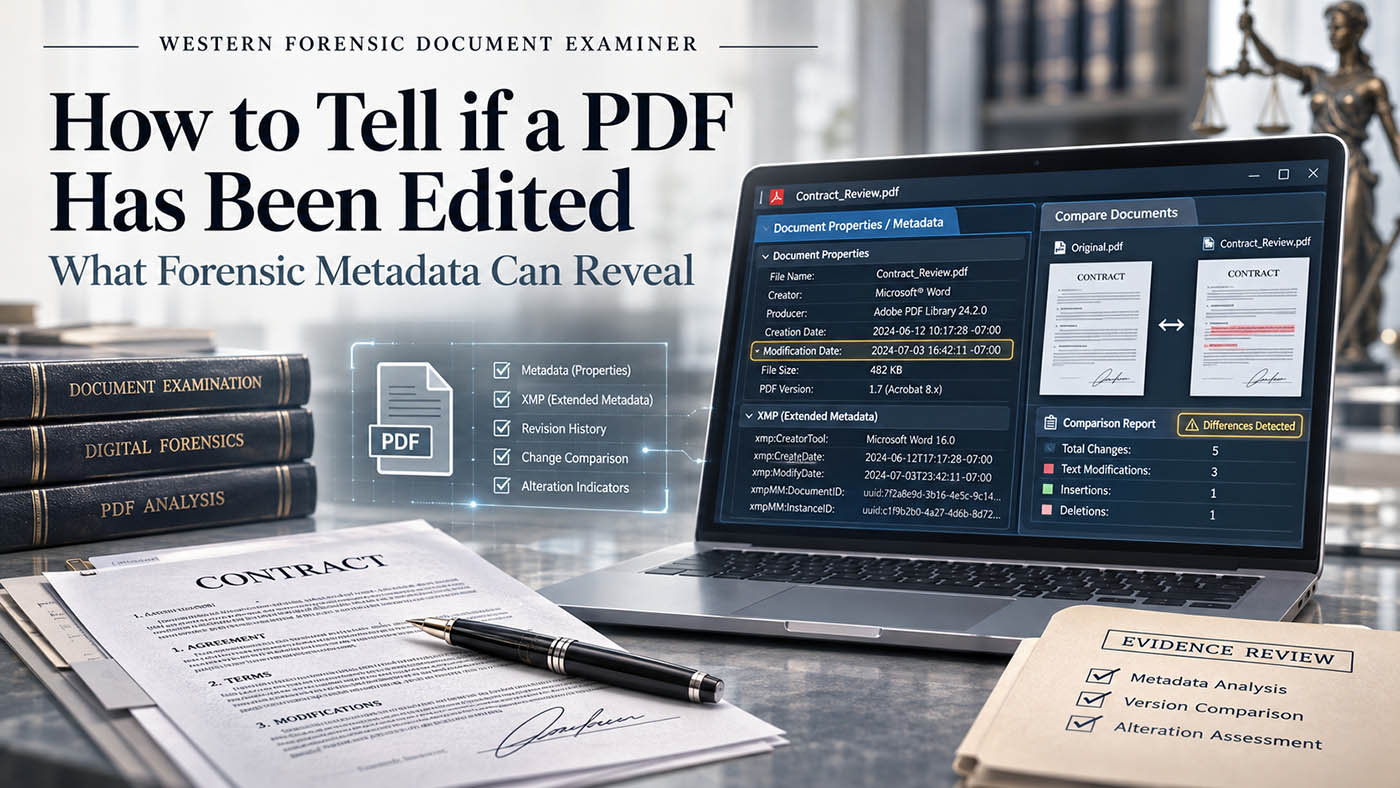
A contract is circulated as a PDF. Later, one party questions whether a payment term changed after the document was finalized. The file may appear ordinary on screen, but its metadata and internal structure can contain information about how it was produced and saved.
Forensic metadata analysis begins by identifying the actual file under examination and the records available for comparison. A recorded date alone cannot establish that content was fraudulently altered. [1, 2]
What PDF Metadata Can Show
A PDF can contain document properties, embedded metadata, and information about the software used to create it. The significance of any field depends on the application that recorded it and the history of the file. [2, 5]
- Creation date: The date associated with creation of the PDF file, which is not necessarily the date the underlying agreement was written or signed.
- Modification date: The date the file was last saved by software that records this field. It is often the same as the creation date, and some applications do not update it consistently.
- Creator: The application that created the original document or content, such as Microsoft Word, when the PDF was converted from another format.
- Producer: The application or process that generated the PDF from that content. Creator and Producer are distinct fields; their values can help identify the document’s production path. When the Creator and Producer fields identify different applications, that information can help establish how the PDF was produced. Different values are not necessarily suspicious. For example, a document created in Microsoft Word and converted using another PDF application may legitimately identify both programs.
- Author, title, and custom fields: Descriptive entries that can supply context but do not independently identify who wrote, signed, or approved the document. [5]
How to Check a PDF’s Document Properties
In Adobe Acrobat, open Document Properties and review the Description information. The Additional Metadata area can contain further entries, including XMP metadata. These displays provide a starting point for inspection; viewing them is not itself a forensic authentication test. [2, 3]
For PDF metadata analysis in a dispute, the examiner should compare the available embedded fields with the document’s structure and independent records. The original evidence file should be preserved before any analysis is performed.
How to Tell When a PDF Was Created
The PDF creation date records information about the electronic file, not necessarily the event described in it. A contract signed on paper in March and scanned into a PDF in June can legitimately display a June creation date. The same distinction applies to PDFs exported from Word or other source documents. [1, 2]
Sending an unchanged PDF by email or transferring it to cloud storage does not, by itself, change the dates embedded inside that PDF. File-system and server timestamps are separate records; they can reflect a download, copy, or synchronization event. SWGDE cautions against treating those external timestamps as direct evidence of when the underlying document was created or edited. [9]
Does a PDF Modification Date Prove an Edit?
No. The recorded modification date does not specify what was saved or whether visible wording changed. PDF applications can also edit metadata separately from page content. Its meaning must be tested against other evidence rather than assumed. [2, 4]
Comparing Two PDFs and Examining Retained Revisions
If an earlier copy is available, Adobe Acrobat Pro’s Compare Files feature can identify differences in text and graphics between the supplied PDFs. It can show where versions differ, but the comparison itself does not establish who made a change or whether the change was authorized. [6]
Incremental saves can preserve earlier content inside the later PDF. Instead of rewriting the entire file, an application may append updated objects while leaving data from previous revisions in place. Examination of the PDF’s internal structure can sometimes identify or reconstruct an earlier state even when a separately saved earlier copy is unavailable. A full rewrite, optimization, or other processing can remove that history, so recovery is not guaranteed. [7]
This distinction matters when only the latest PDF survives. The absence of a second file does not necessarily mean the document contains no information about earlier revisions.
What if a PDF Was Changed After Signing?
A certificate-based digital signature is different from a scanned handwritten signature or a signature image placed on a page. Where a PDF contains a verifiable digital signature, Acrobat can provide a signed version and, in supported circumstances, compare it with the current version. Changes made after signing can affect signature validation or be identified as later revisions, subject to the signature’s settings and permitted changes. An image of a handwritten signature does not provide the same cryptographic record. [7, 8]
Can PDF Metadata Disagree With Itself?
Yes. A PDF can contain basic Document Properties in its document information dictionary and a separate XMP metadata record. Creation and modification dates stored in XMP metadata can differ from those in the PDF’s document information dictionary when software updates one location without updating the other. Differences in time-zone representation can also create apparent discrepancies, so the recorded times must be interpreted consistently. [10]
These differences warrant examination of the file and the application workflow. They do not, without additional evidence, establish deliberate tampering.
Example: Two Versions of a Disputed Contract
Consider a hypothetical agreement emailed on April 4 and again on April 12. The later attachment contains an April 11 modification date, and the recipient believes one payment term differs. The original emails and both attachments should be preserved. A comparison can establish whether the text differs, and the available file histories can help clarify when particular versions existed.
If only the April 12 file remains, an examination should still consider whether incremental updates preserve a previous revision within it. Any interpretation must distinguish the existence of a changed term from the separate question of who changed or authorized it. This scenario is hypothetical and does not describe an actual case.
What Evidence Should Be Preserved?
When a PDF is disputed, preserve the original file in the form received. Record a cryptographic hash of the original before working on a copy, and document the source and handling of the file. Retain the original email, attachments, source document, earlier versions, and related correspondence when available. NIST’s digital evidence preservation guidance describes hashing and documented handling as important integrity controls. [11]
A professional review should compare the preserved PDF with any available versions, embedded revision history, and relevant transmission records. Avoid editing, re-exporting, or saving over the original during preliminary inspection.
When Is a Forensic PDF Examination Appropriate?
A forensic review is appropriate when parties dispute a PDF’s contents, the sequence of changes, the circumstances of signing, or the history of a document used in a legal or financial matter. Relevant materials can include contracts, deeds, wills, business records, and documents submitted in litigation.
The available material determines the scope of a reliable conclusion. In some cases, the evidence supports a comparison or timeline; in others, an incomplete record limits what can be established. [1, 11]
Request a Metadata or Document Examination
Kathy Carlson, CFDE, CQDE, is a certified and court-qualified forensic document examiner who assists
attorneys, businesses, and individuals with questioned documents. If a PDF or other electronic record is
disputed, Kathy can review the circumstances and discuss whether a document examination or additional
technical analysis is appropriate.
Learn more about metadata in document examination and document examination services. Contact Kathy for an initial consultation or call 970-275-6846.